Showing posts with label culture. Show all posts

A Generation Apart

Checklist

Ok let see here...

  1. Blog with abstract title - Check
  2. Independent coffee shop - Check
  3. Thrift store hat - Check
  4. Minimal amount is savings - Check
  5. Shirt supporting third world development - Check
  6. Classic wooden pipe - Check
  7. Flip flops - Check
  8. Stockpile of angst - Check

Yep....it's official. I'm a Millennial. 

I thought I might avoid stereotypes and forge my own identify, only to find that I became the same as the rest of my generation. Whoops! 

Trees and Their Apples

Each generation has its identifiers. Their little quirky attributes and stereotypes that follow them to the grave. Most of the time, these identifiers are clothing or dance styles. Or whatever addiction is most popular at the time.

I think my generation is addicted to being angsty and starting arguments.

Granted, every generation has rebelled against something. Mine just has unlimited resources for pushing out opinions and ideas that other generations didn't have. Like Facebook and Twitter. 

Sadly, the newest generation is suffering our decisions just as much, if not more, than we suffered the decisions of those who have come before us. 

Social media has changed the way we interact with each other and has fed our anxieties and fears. Narcissism is at an all time high. Porn is rampant. And we wonder why there are more STDs than ever,  why rape is increasing, or why youth don't seem to have any self-respect. Or respect in general. 

We can sit here and talk about how the GenX and GenY groups have destroyed our nation and the economy, but what about what we are doing to our world.

Let's Get to Work

It's time to stop complaining and start renovating. We want our elders to accept responsibility for their choices, but if we wait for that then we may never see the changes we crave. And if we don't own our faults, the GenZ is really going to suffer!


Aspirations

What is something worth aspiring towards? What is worth doing? Each of my friends has something they aspire to be or do. For one it is to be consistent in all that he believes and to teach others to be consistent as well. Another seeks to live with discipline in the realm of Christian tradition and to have vast understanding of historical theology and understanding. Another aspires to good biblical theology and an understanding of the ancient languages that form the holy Scriptures and to teach others. And another seek to become well versed in psychology and to understand the mind to be able to reach out to broken men and women caught up in a world of brokenness, depression, sex slavery, and abuse.

All of these things, though in many ways very similar, are unique and independent aspirations that a beautiful to behold. Not all, however, have the same aspirations nor do people always appreciate these goals fully. Not everyone understands why one might want to start a nonprofit that helps the sexually abused as well as the abuser. Not everyone sees the importance of tradition or of original texts.

So here is where I find myself a little lost. I have nothing that I really specialize in, and I cannot think of single thing that I am passionate about. What is this? Apathy? Maybe. I'm really not sure. I mull over a thousand different things that I could pursue. I come across causes and the like that inspire me and even spark a desire to act, but all too soon that spark fades and I'm back at square one.

I confess that this reality scares me a little. It leads me to question myself and to wonder if there is an area I am broken in. There is. Depression and self-pity are two of the diseases that plague my soul and have for a very long time. It would be pointless and dishonest to deny that this is true. The consistent self-destructive thinking cripples my advance toward something I want to do. Before I even begin my task I've already told myself that I can't do it and I burn the bridge before it's even built.

I think that what I struggle with is more common than I once believed. I am hearing more and more about people who struggle with the same things as I. I know that there are events and relationships throughout my life that have played important factors into who I am and how I behave, but I must accept ultimate blame for what I do or don't do. Could a lot of crap been avoided by the actions of others? Absolutely. Will they be held responsible? Of course, but so will I. I will take the blunt of the blame just as I will take the measure of responsibility for what I did and did not do for others in need.

My responsibility now is to rise above my habits and the darkness that threatens me. I will seek help when necessary; I will make plans and push myself to get past the written lists I've developed. I will seek and trust God to lead me through the dark valleys that will build up my soul and make me holier tomorrow than I was yesterday. I will aspire to be a godly person and that faces every adversary with boldness and faith, to be free of cultural shackles that give me false interpretations of what is greatness and what is admirable. I will aspire to be the fullness of what God has desired to be the person of Stephen Green.


Grace and Peace,

Stephen


The Weight of Expectation

Most of us grow up in environments that come with a set of expectations. Some are healthy and some not so healthy. More often than not, these expectations are unwritten and, nearly as often, unrecognized for what they truly are. I experienced many of these said expectations in my own life, and I have watched many others either bow to or rebel against the ones set for them.

“Love makes the world go round, but money greases the wheel.” These are the words that I hear every time I have a conversation with my grandfather. He set high expectations for my brother and I to study hard, do well in school, and get degrees that led to jobs that [aid well and allowed us to live comfortably. There is nothing wrong with him desiring his grandchildren to live well, but the problem lies in not being willing to accept that we might desire to pursue careers and callings that lack significant income.

The expectation that I will work hard and work to take care of my future family is more than reasonable, and definitely biblical, but as a single man I have less responsibilities to uphold and can live with less income. Not work less hard, but definitely not worry as much about having the means to live “comfortably.” In fact, I do not find in necessary for me to gain more income just for the sake of having my heat turned on for the winter. I can survive just fine without it, as have hundreds upon hundreds of my ancestors. No, not needed. I do, however, have the responsibility of paying off medical debts and student loans and therefore income is essential for accomplishing this, and for getting sufficient food to be healthy enough to work. (Which...yea failing on that one...)

At the same time, while there are those that bear the weight of high-success expectations, many more bear the weight of low-success expectations. Those who are told their entire lives by friends and family that they will never amount to anything, that they will end up broke and pregnant, that they will their lives on the streets as a beggar. There are those that have no hope for fulfilling their dreams or living an average life because of a community that chains them down by broken expectations, and others still are unmotivated for having not been given expectations to begin with.

The worst is probably the expectations we place upon ourselves. If we really thought about it, there are no expectations outside of the ones we place upon ourselves. How do other peoples’ expectations enslave us? We adopt them in our lives and nail ourselves to them. We rate our success and failures according to what has been presented to us. We are at fault. I...am at fault. So how do we remedy this?

Recognizing the issue is a great first step! Acceptance of the truth is almost always a needed ingredient to true change! Once we see what is happening we can begin acting on it.

Now, here is the hard part. I can tell you from personal experience that knowing a truth does not make acting on it easy to do. In fact you might have to go back to step one a few times. The next step is a matter will power and discipline. Willpower to push oneself to do and to NOT do; to resist the pushing and twisting of other people intrusions and forced philosophies.

Don't get me wrong, we need other people to push us and to raise our expectations to a healthy level that will make us better people, but without breaking us. We need to understand that living our dreams and also living in the realm of responsible, well-balanced life requires that we engage in community and seek counseling form older and wiser people. To make sure that we don't pursue "dreams" that are completely foolish (think of some American Idol contestants).

Sometimes our dreams and desires need to be reformed. These change as we begin to understand ourselves, our talents, and our abilities. I will never be an Olympian. I would be a fool to chase after that, but I can be a much more fit man and I can pursue that. I will never get a hit record, but I can sing and I can practice that and use that in significant ways. I have a talent for teaching and I can pursue that route (though I definitely won't be "greasing the wheel" with that job).

Lastly, pray. Seek God and ask Him to guide you and help you to see His truth. The truth of who God made you to be and what He wants you to do. God's expectations not without struggle and are not accomplished without the exertion of energy, but they are easy and light. When we pursue the expectation of Christ, we honor Him and He helps us where we lack strength. We dwell in a healthy and freeing set of standards.


You might just suddenly find everything flipped on ya. 


Grace and peace,

Stephen

When Worlds Colide

This past Sunday I was in Chattanooga visiting family, and while I was there I went to my old church. There were several Russians who had flown into the country to be able to go on a retreat that the church had put on over the weekend. During the worship portion of the service, the worship leader called up one of the Russians, who was the worship leader for the church back in their home town, to join him on stage. It was there that I experienced the beauty of hearing "How Great is Our God" sung in RUSSIAN! What was truly beautiful was when all the Russians began singing and, at the same time, the Americans in the room began singing out in English. I was lost in a in the miscellany of voices and the intense combination of language.

In that moment I saw the beautiful side-effects of Pentecost, people of various languages and cultures singing in unison of the glory of God and the wonder of our Christ! This is the beauty of the new covenant! That all peoples and all tongues and all cultures are now welcomed into the fold of God! That the Gospel will infiltrate the fabric of humanity and all men will sing together "Holy Holy Holy Lord, God of power and might. The heavens and the earth are full of Your glory! Hosanna in the highest!" From the East to the West, the Church shall be united once again. From the East to the West Christ will be Glorified. From the East to the West there will be peace, love, prosperity, and an end to injustice, poverty, and evil. All by the power of our God: Father, Son, and Holy Spirit, Who is our "world without end".

Grace and Peace,

Stephen

Christianese

Christianese…such a strange language, but it goes far beyond mere words and phrases. No, it’s full of non-verbals and habitual, repetitive actions. So much is communicated through action. Generally, Christianese is sprinkled in various parts of peoples’ language and lifestyles, only coming out in certain place, but occasionally it is possible to find some that have completely drowned themselves in it. Christians have created weird cultures.

Are we not supposed to be different? Are the cultures of the Church not supposed to vastly contrast the cultures of the world?

It is not wrong that the Christian culture is…different. It must not, however, be assumed that all Christian culture is healthy of beneficial. Too much Christian culture goes unchecked and unexamined. Do we not think of the consequences of our actions and trends? When did the Church become soft and about coffee and side-hugs? From congregations who have “no problems” in life to others that are experiencing unending onslaught of turmoil at the hands of Satan himself because they “are getting it right”.

“Dress up before you come.”—“Come as you are” 
“Be reverent”—“be free!”
“Chew gum and we’ll burn you”—“if you don’t leave a coffee stain on our carpet then you haven’t gotten the full experience!”

So what honors God? All culture is broken and sinful. There is no perfect culture, no perfect lifestyle. 
What is…church? I’m not asking about big “C” church. I’m asking about our congregations and faith communities. What is our interaction? What do you think of when you think upon your faith community? Who are they? Why are they? What focus or vision are they promoting? What were faith communities in the era of the early Church and how much of that should we be reflecting? It is a hard question to answer indeed. It’s easy to say “If it was good enough for them then it is good enough for me” or “Since it’s what early Church did than it must be most right.” We forget that the early Church identified with what they did because it was culturally significant. Yes, there were various elements of their worship that separated them from “normal culture”, but it wasn't 100% different. Worship is affected by culture…and culture is affected by worship.

Americans’ worship of “rights” and “fairness” led to where we are. Worship of new, better, faster, and stronger is a disease that is eating away at the soul of our nation and communities. The Church of America has been affected by this attitude! Prayers and proclamations of blessings and good things being spoke over people and sermons on faith for financial peace and stability have multiplied in the church. Perversion of the understanding of salvation and what it means to be an “adopted child of God”.

Or have they? Do I even know what God truly desires of us or how he interacts with us? Who am I to say one thing or another? Does God not reward the faithful and those who seek purity and holiness?

Grace and Peace,

Stephen

The Thief and the Pharisee: Seeing Christian Themes in "Les Misérables"

In the New Testament, we are presented with a couple of interesting classifications of people with which Christ interacts: the Thief and the Pharisee. Many people that Jesus interacted with were considered thieves, some even became His disciples. The thief that stands out the most is the one that hung next to Christ on the cross. This thief recognized his depravity, and saw the light of Christ. He did not ask for forgiveness, but instead he humbly asked that Christ would remember him in His kingdom. That man found salvation that day.

The Pharisees were the legalistic religious leaders of Judaism. They were spiritual leaders of the people in the region of Judea and Palestine, but to whatever was required by the Law they added stricter guidelines and boundaries. They went above and beyond the Law and insisted that all others followed. They showed no grace, even if what was broken was not the Law, but merely their traditions. These men opposed Christ for showing grace to sinners and for not following their petty demands.

When watching the movie Les Misérables (starring Russell Crowe, Ann Hathaway, and Hugh Jackman) I recognized some substantial Christian themes throughout the story. Many might say that the religious theme is merely a reflection of the culture of the time and the authors desire to capture the state of France in the early nineteenth century. I believe that there is much more depth to it than an appeal to historical accuracy.


For example, is it not odd that when the priest invites Jean Valjean into the parish, he offers “wine to revive [him] and bread to make [him] strong” and yet never actually gives him either? He was actually referring to the Eucharist and actually speaking of the healing power of Christ! After this Valjean betrays the priest (who is a representative of Christ to the people) by stealing the silver, which I another interesting element to the story for Christ was also betrayed for silver.
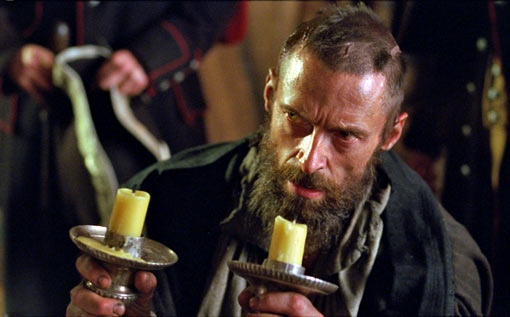
Valjean is dragged back to the priest by the local police and we see the theme continuing. The priest is now wearing white (as opposed to black the night before) and his robes are decorated with designs of green. Additionally, there is a depiction of the Eucharistic bread and wine at the center of his chest with beams of light emanating from them. This is clearly a reflection of the revelation that our former prisoner is receiving as the priest approaches carrying the two silver candle sticks—also  symbolic in this moment as the Light now shines on Valjean’s soul. The priest once again shows grace and mercy to him; then he speaks a blessing over him.

Valjean then wrestles with the condition of his soul and questions who he is. He renounces his own name and then takes up a new name. The priest shows grace and offers bread and wine (Christ), and Jean Valjean walks away from the parish a completely changed man; he lives out the next 8 years as Mr. LaMare and undergoes a severe change of attitude and action. Valjean is the thief. He did wrong and broke the law, but found redemption in Christ. Under his new alias, Valjean becomes a mayor and successful business man. During this time he makes significant strides to repair a once broken community, providing jobs and cleaning the streets.

Here we are first introduced to Fantine, a young woman working herself to death to try and take care of her daughter in lew of a terrible situation where they were abandoned by the child’s father. Fantine is working in a factory that makes, of all things, rosaries! Could this be a reflection of the author’s opinion of the Church? These women are examples of those who claim to be righteous and devout, but they are gossips and vicious lions. In but a moment, they arrogantly invade Fantine’s privacy and her secret is revealed. The other women, who have the audacity to call Fantine “sister”, betray her to the rather “forward” foreman. These women speak evil of Fantine and influence the foreman to have her thrown out on the streets. Because of their hypocrisy, Fantine is destroyed and is tossed away like trash. She soon finds herself prostituting herself away to make ends meet.

Now enters the Pharisee: Javert. Javert is the shining example of a police officer who follows the law to the letter! Javert is the man who set Valjean out from the prison and later the man who hunts Valjean for breaking parole. Javert continually displays disdain for Valjean and declares him a con, thief, and sinner. At one point he even likens Valjean to Lucifer himself and makes statements such as “Honest work, just reward: that’s the way to please the Lord” as he steps in to enact “justice” without giving heed to the pleas of Fantine. Javert sees himself as a righteous man because of his obedience to the law and his staunch support of the law.

There is a constant clash of philosophy and worldview between Javert and Valjean as their lives unfold. The thief has become a hero, a leader of men and the saver of lives; the pharisee an oppressive and obsessed hunter of men. Eventually, Javert finds himself at the mercy of Valjean who has spent over a decade fleeing in fear. The thief stands over the pharisee with a knife in one hand and gun in the other. Then he cuts the ropes and says “Be gone. There is nothing I blame you for. You’ve done your duty and nothing more.” At this great act of mercy and grace Javert is flabbergasted! He cannot understand the mercy and grace being shown to him. He then tells Valjean that he will not make a life bargain, but Valjean turns and says that his allowing Javert to live was not a bribe, and that if he would wait but a day, he would turn himself in.

Javert is later faced with the choice of killing the man he has hunted for so long or letting him walk away to save the life of another. His worldview then crumbles. In the face of the possibility of being, he throws himself into the river, trapped by his legalistic framework of reality and his unwillingness to not live in a world where those who do wrong can be redeemed.

These two characters bear the same goal, to uphold the will of God and to be living instruments of the His will, but they have very different understandings of God. Ultimately, the one that looses himself in the Law and becomes fixated on the works of perfection and “righteousness” becomes tethered down by his pride and self-centeredness which leads to his committing the greatest sin short of blaspheming the Holy Spirit: suicide (which in this case could be argued as one and the same).

In the act of killing himself, he proverbially slaps God in the face, as well as all of the created order, and demands no part in it, insulting his Creator. Alas, we do not see Javert in the final scene with the others who are standing on the great barricade of liberty that is “Heaven.”


Les Misérables, is a movie rich in philosophy and theology. We often miss the messages that authors and film directors are trying to get across. As Christians we have a responsibility to engages culture and the arts, but he have given into the laziness and desire for simple amusement; ignoring the need to engage with our intellect for the sake of focusing on emotions and self-pleasure. May we all learn to engage more fully and to not take for granted what artists and authors have laid out for us to engage.

Peace be with you.

Stephen

The Darkness Within

A friend of mine recently introduced me to a band called "Imagine Dragons" and I immediately fell in love with three songs in particular. I would advise listening to their songs "Radioactive" and "Bleeding Out", but the song that I am currently most compelled by is the song "Demons." As a courtesy, I have add the link to the song via youtube for your listening pleasure, as well as a point of reference to what I am now writing about.

This song pulls upon my desire for perfection and reminds me of the overwhelming reality that I simply am incapable of reaching perfection. I am full of darkness and I am prone to greed, pride, deceit, and failure. This is the reality of the human condition; we are ever seeking greatness but always falling short because of the sin that taints our souls.

Those of us who have been Church leaders (whether voluntary or paid staff) can deeply relate to the words of this song as is screams of a need to be there for others and the "need" to hide the demons that lay just beyond the surface of our skin. Church leaders are often too concealing of the faults and sinful natures for a variety of reasons. While it is not possible for a Priest, Church leader, or volunteer to be completely transparent about their sinfulness, it is necessary that a certain level of transparency be maintained.

Despite the fact there is always going to be a measure of sin within our hearts (until the final purification, at the end of all beginnings) we can stand in the comfort that the True and Holy One knows and understands all and has deemed it is a meet and right and joyful thing to shower grace upon humanity and upon His redeemed. We can never be perfect, but that does not mean we are not useful or that we have lost our value as God's special creation on Earth!

I hope that you listen to the lyrics of this song and that it moves you in such a deep and wonderful way; that you will allow the Holy Spirit to speak to through the words of another.

Be intentional in all action, attentive in daily encounters, and be present in life.

Peace be with you,

Stephen 

#ChristiansAndTheirWeirdNeedToMakeStatementsInHashtags

I love culture. Its complex, it's beautiful, and its the structure in which society functions and operates. Culture is full of wonderful and hideous elements of humanity, but it is essential. Culture is the stumbling block of Americans...and the Church. Americans often are insensitive to cultures other than theirs. Christians typically are either far removed from culture to the point of irreverence or they try so hard that they make it awkward.  Why is this? I haven't a clue.
                     (The above pic can be found on http://www.stuffchristianculturelikes.com/2008/08/15-believing-that-america-is-christian.html)
It is important to understand that the Church is a creator of culture, but to some degree must be aware of the culture that it indwells. Never to conform to the culture and give in to sin or be lax on doctrine, but adaptive none the less. To be apart of culture does take some thoughtful effort, but it should not be such a strain. There is such a thing as..."overkill" (or should we call it "overtweet"?).

Not a day does by that I do not see a picture or some text on Facebook that makes me "smh" (shake my head). I am appalled by the "Share if you love Jesus! Don't if you love Satan" posts. What point is there to this? To manipulate people's weak consciences and emotional states to get them to post something? Does reposting a picture bring some sort of legitimacy to your love of God? You may not think this is a big deal...but what happens when statements like these leave the confines of Facebook and simple matter of reposting and enter into the Church -culture in the real world? What happens when pastors and/or youth pastors start making these kind of statements to get people to do what they want them to? It's a dangerous place to be.

Along the same lines of the previous paragraph, why do so many Christians leave weird hash-tags?

#ChrsitansLivinItReal
#GodLovesMe
#LivinTheBlessedLife (I laugh every time)
#Truth
#TheWord

..and the list goes on. I'm not saying it's wrong to say these things or that the statements are untrue. I'm simply questioning our overuse of these statements and what appears to be a need for people to know beyond a shadow of a doubt that you #LoveJesus or that your #BlessedAndHighlyFavored (I actually hate this one for a variety of personal and theological reasons). What I'm saying is go and be real. Be "in the World but not of it" in such away that you are light in the World and salt to the culture.

#PeaceBeUponYou (lol)

Stepheno Verde

Hopeful and Numb

Recently, I was listening to top 40 radio and I noticed an interesting trend. Apart from Adele, the majority of music that you will here will consist of partying, sex, lyrics about how "fly" someone is and how amazing they are, avoiding problems in life and just enjoying the moment, or just complete nonsense (*cough cough* Nikki Minaj cough*).

It seems that having depth or meaning to a song is no longer necessary for it to be good. So long as it has a good beat and one can escape their own reality for a moment, then it's all good. I'm amazed at the crudeness of some songs like "Whistle" by Flo Rida, which totally shows disrespect for women and degrades the value of sex...but who  surprised? America devalued sex roughly four decades ago. Whet really boggles my mind is that there are people that actually listen to this junk. Don't get me wrong, there are songs that I hear on top 40 radio that I quite enjoy listening to, and actually brings benefit to my life. Like Adele who expresses depth and true emotion, or the song "Titanium" that is full of emotion and strength. 

The thing is that people have turned to music to escape, to feel numb to the pain they are experiencing and to gain hope for the future. I fear that this is having a very profound affect on the minds of Americans, as well as others in the world who listen to them. Hope, true hope that brings about an end worth having is only found in Christ, but it isn't wrong to have a little boost from music either...so long as that "hope" isn't rooted in pride and false conception of one's self. 

Music is a gift, can we please stop abusing it by putting "artists" on the stage who can't do anything more than talk about themselves and all the people they have slept with? Perhaps we can even get singers who sound good without the aid of a computer! Ok ok...you're right...one miracle at a time...