In the New Testament, we are presented with a couple of interesting classifications of people with which Christ interacts: the Thief and the Pharisee. Many people that Jesus interacted with were considered thieves, some even became His disciples. The thief that stands out the most is the one that hung next to Christ on the cross. This thief recognized his depravity, and saw the light of Christ. He did not ask for forgiveness, but instead he humbly asked that Christ would remember him in His kingdom. That man found salvation that day.
The Pharisees were the legalistic religious leaders of Judaism. They were spiritual leaders of the people in the region of Judea and Palestine, but to whatever was required by the Law they added stricter guidelines and boundaries. They went above and beyond the Law and insisted that all others followed. They showed no grace, even if what was broken was not the Law, but merely their traditions. These men opposed Christ for showing grace to sinners and for not following their petty demands.
When watching the movie
Les Misérables (starring Russell Crowe, Ann Hathaway, and Hugh Jackman) I recognized some substantial Christian themes throughout the story. Many might say that the religious theme is merely a reflection of the culture of the time and the authors desire to capture the state of France in the early nineteenth century. I believe that there is much more depth to it than an appeal to historical accuracy.
For example, is it not odd that when the priest invites Jean Valjean into the parish, he offers “wine to revive [him] and bread to make [him] strong” and yet never actually gives him either? He was actually referring to the Eucharist and actually speaking of the healing power of Christ! After this Valjean betrays the priest (who is a representative of Christ to the people) by stealing the silver, which I another interesting element to the story for Christ was also betrayed for silver.
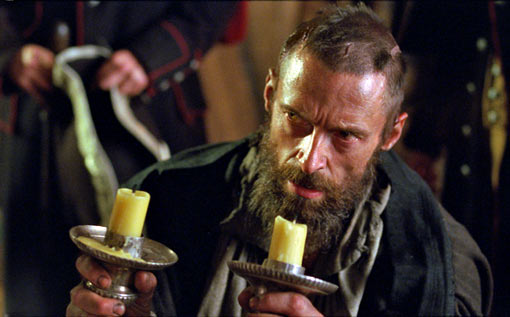
Valjean is dragged back to the priest by the local police and we see the theme continuing. The priest is now wearing white (as opposed to black the night before) and his robes are decorated with designs of green. Additionally, there is a depiction of the Eucharistic bread and wine at the center of his chest with beams of light emanating from them. This is clearly a reflection of the revelation that our former prisoner is receiving as the priest approaches carrying the two silver candle sticks—also symbolic in this moment as the Light now shines on Valjean’s soul. The priest once again shows grace and mercy to him; then he speaks a blessing over him.
Valjean then wrestles with the condition of his soul and questions who he is. He renounces his own name and then takes up a new name. The priest shows grace and offers bread and wine (Christ), and Jean Valjean walks away from the parish a completely changed man; he lives out the next 8 years as Mr. LaMare and undergoes a severe change of attitude and action. Valjean is the thief. He did wrong and broke the law, but found redemption in Christ. Under his new alias, Valjean becomes a mayor and successful business man. During this time he makes significant strides to repair a once broken community, providing jobs and cleaning the streets.

Here we are first introduced to Fantine, a young woman working herself to death to try and take care of her daughter in lew of a terrible situation where they were abandoned by the child’s father. Fantine is working in a factory that makes, of all things, rosaries! Could this be a reflection of the author’s opinion of the Church? These women are examples of those who claim to be righteous and devout, but they are gossips and vicious lions. In but a moment, they arrogantly invade Fantine’s privacy and her secret is revealed. The other women, who have the audacity to call Fantine “sister”, betray her to the rather “forward” foreman. These women speak evil of Fantine and influence the foreman to have her thrown out on the streets. Because of their hypocrisy, Fantine is destroyed and is tossed away like trash. She soon finds herself prostituting herself away to make ends meet.

Now enters the Pharisee: Javert. Javert is the shining example of a police officer who follows the law to the letter! Javert is the man who set Valjean out from the prison and later the man who hunts Valjean for breaking parole. Javert continually displays disdain for Valjean and declares him a con, thief, and sinner. At one point he even likens Valjean to Lucifer himself and makes statements such as “Honest work, just reward: that’s the way to please the Lord” as he steps in to enact “justice” without giving heed to the pleas of Fantine. Javert sees himself as a righteous man because of his obedience to the law and his staunch support of the law.
There is a constant clash of philosophy and worldview between Javert and Valjean as their lives unfold. The thief has become a hero, a leader of men and the saver of lives; the pharisee an oppressive and obsessed hunter of men. Eventually, Javert finds himself at the mercy of Valjean who has spent over a decade fleeing in fear. The thief stands over the pharisee with a knife in one hand and gun in the other. Then he cuts the ropes and says “Be gone. There is nothing I blame you for. You’ve done your duty and nothing more.” At this great act of mercy and grace Javert is flabbergasted! He cannot understand the mercy and grace being shown to him. He then tells Valjean that he will not make a life bargain, but Valjean turns and says that his allowing Javert to live was not a bribe, and that if he would wait but a day, he would turn himself in.
Javert is later faced with the choice of killing the man he has hunted for so long or letting him walk away to save the life of another. His worldview then crumbles. In the face of the possibility of being, he throws himself into the river, trapped by his legalistic framework of reality and his unwillingness to not live in a world where those who do wrong can be redeemed.
These two characters bear the same goal, to uphold the will of God and to be living instruments of the His will, but they have very different understandings of God. Ultimately, the one that looses himself in the Law and becomes fixated on the works of perfection and “righteousness” becomes tethered down by his pride and self-centeredness which leads to his committing the greatest sin short of blaspheming the Holy Spirit: suicide (which in this case could be argued as one and the same).
In the act of killing himself, he proverbially slaps God in the face, as well as all of the created order, and demands no part in it, insulting his Creator. Alas, we do not see Javert in the final scene with the others who are standing on the great barricade of liberty that is “Heaven.”
Les Misérables, is a movie rich in philosophy and theology. We often miss the messages that authors and film directors are trying to get across. As Christians we have a responsibility to engages culture and the arts, but he have given into the laziness and desire for simple amusement; ignoring the need to engage with our intellect for the sake of focusing on emotions and self-pleasure. May we all learn to engage more fully and to not take for granted what artists and authors have laid out for us to engage.
Peace be with you.
Stephen


